Unlock tax exemptions for your NGO, Trust or Charitable Institution โ and give your donors the benefit of tax deductions on their contributions.
Section 80G of the Income Tax Act, 1961 allows donors โ individuals, companies, firms, and HUFs โ to claim a deduction on donations made to approved charitable organisations. When your organisation holds an 80G certificate, every rupee donated to you becomes more attractive because the donor gets a tax benefit on it โ typically 50% of the donated amount is deductible from their taxable income.
This registration is not just a legal formality. It is a trust signal and fundraising tool. Donors โ particularly corporate donors fulfilling their CSR obligations and high-net-worth individuals โ actively seek organisations with 80G status before committing their contributions. Without 80G, your organisation misses out on a significant pool of potential supporters who require the tax benefit.
80G registration is granted by the Principal Commissioner or Commissioner of Income Tax and is currently valid provisionally for 3 assessment years for new applicants, after which regular registration must be obtained.
Section 12A of the Income Tax Act provides tax exemption on the income earned by a charitable or religious trust or institution. Without this registration, the total income of the trust โ including donations, grants, corpus funds, and interest earned โ is taxable at normal rates, just like any other entity.
Once registered under Section 12A (now governed under Section 12AB after the 2021 amendment), your organisation's income that is applied towards its charitable objectives is completely exempt from income tax. This means more of every rupee you receive goes directly toward your mission rather than toward tax payments.
12A registration is a prerequisite for 80G. You must hold or be applying for 12A before your 80G application can be accepted. Both can be applied for simultaneously using a single Form 104.
Any non-profit entity engaged in charitable, religious, educational, or social welfare activities that receives income or donations should obtain these registrations
Organisations working in social welfare, poverty alleviation, rural development, women empowerment, or environmental protection.
Temples, mosques, churches, gurudwaras, and other religious organisations that also carry out charitable activities for public benefit.
Schools, colleges, coaching centres, vocational training institutes, and educational trusts established for public benefit without profit motive.
Charitable hospitals, dispensaries, health camps, medical research organisations, and patient welfare societies.
Foundations engaged in environmental conservation, wildlife protection, animal rescue, afforestation, or climate-related charitable work.
Organisations focused on child rights, women safety, rehabilitation, skill development, or support for differently-abled individuals.
One of the most important updates under the Finance Act 2020 and the subsequent rules is that an organisation can now apply for 12A and 80G registration simultaneously through a single application โ Form 10A/Form 104, prescribed under the Income Tax Rules. This saves significant time, effort, and paperwork for charitable organisations.
Form 104 is the prescribed application form for registration or approval of a charitable or religious trust or institution seeking exemption under Section 12AB and approval under Section 80G. It is filed electronically on the Income Tax e-filing portal under the category of "Non-Profit Organisation (NPO)".
The form captures complete details of the organisation โ its constitution documents, activities, income, expenditures, financial statements, governing body members, and objects โ which the Income Tax Department reviews before granting approval.
File once for both 12A and 80G using Form 104 โ no separate submissions needed.
Filed electronically on the Income Tax e-filing portal with digital verification (DSC/EVC).
New organisations receive provisional approval for 3 assessment years before applying for regular registration.
Regular registration under 12AB must be renewed every 5 years. 80G approval must similarly be renewed periodically.
Issued by the Income Tax Department in response to your Form 104 application โ your official proof that registration and approval have been granted
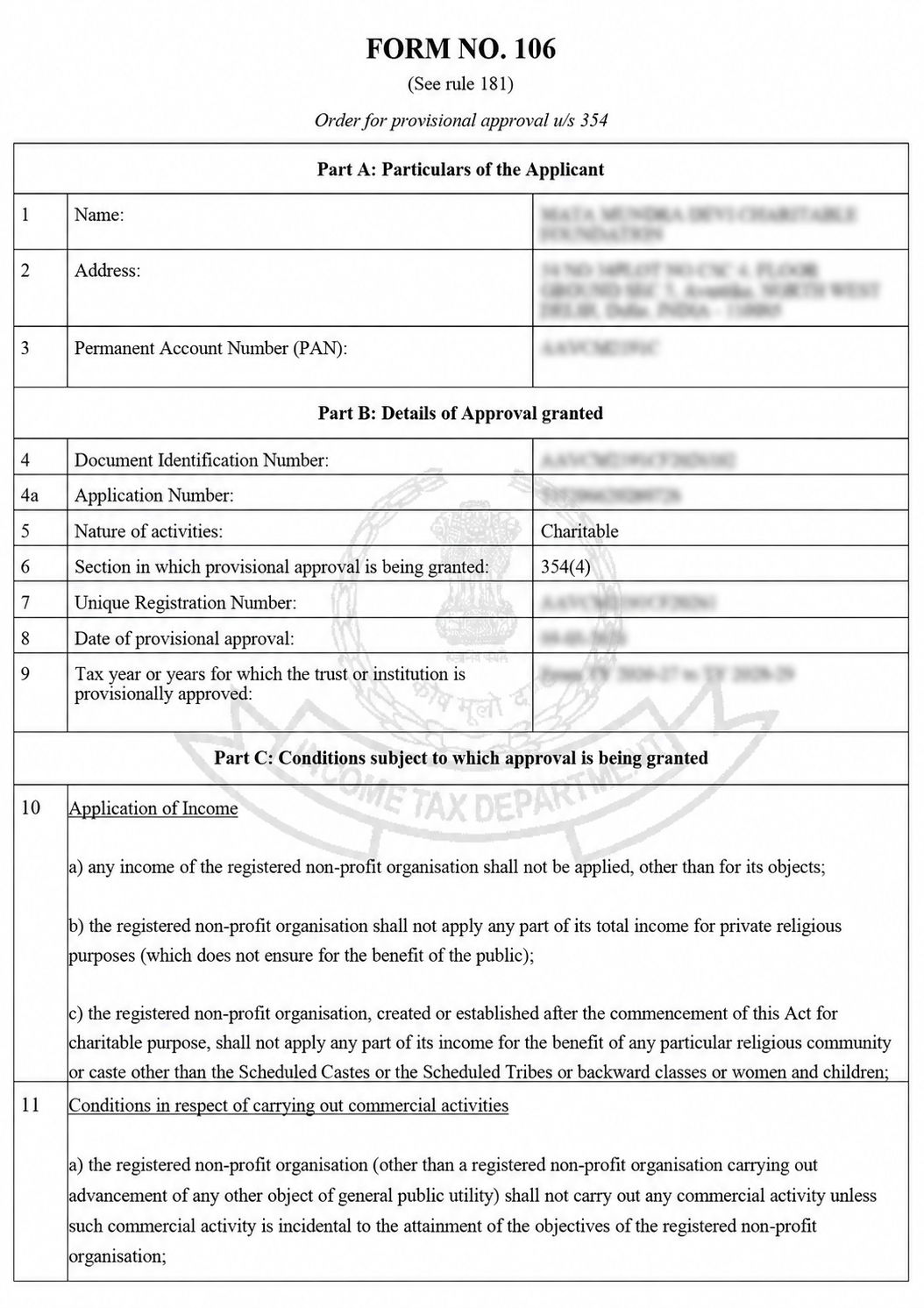
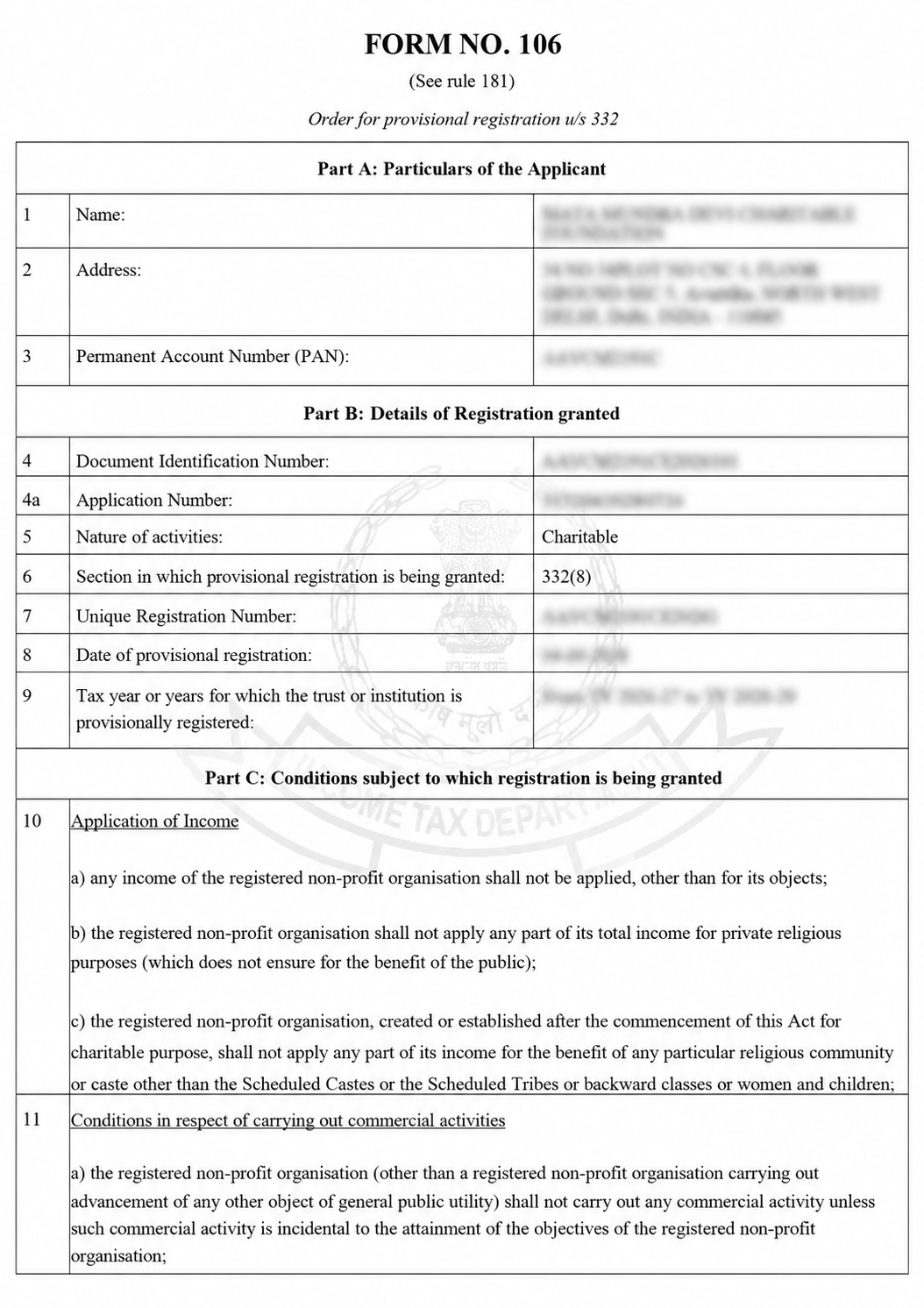
Form No. 106 is not an application โ it is the official order passed by the Income Tax Department in response to your Form 104 filing. Once the Department processes your application and finds it complete and in order, they issue Form 106 as the formal legal document granting your organisation its registered and approved status. It is digitally signed by the Principal Director of Income Tax and carries a Unique Registration No. assigned specifically to your organisation.
Depending on the section under which your organisation is being registered or approved, two separate Form 106 orders are issued simultaneously โ one under Section 354(4) for the 12A income exemption approval, and one under Section 332(8) for the 80G donor deduction registration. Together, these two documents constitute complete proof of your organisation's full tax-exempt and donor-benefit status. Both are valid provisionally from TY 2026-27 to TY 2028-29 for new applicants, covering 3 assessment years.
When your Form 104 is approved for income exemption under Section 12AB of the Income Tax Act, the Department issues a Form 106 order citing Section 354(4). This is titled "Order for Provisional Approval u/s 354" โ note the word "Approval" here, which is the legally precise terminology used for 12A.
This order confirms your organisation is now a provisionally approved charitable institution exempt from income tax on all income applied toward its registered charitable objects. The document includes your Document Identification Number, a Unique Registration Number, the date of approval, the nature of activities approved (Charitable), and the specific tax years covered (e.g. TY 2026-27 to TY 2028-29). It also lists all binding conditions โ proper application of income, commercial activity limits, separate books of accounts, and legal compliance requirements โ which your organisation must adhere to throughout the validity period.
This Form 106 is your mandatory proof when filing ITR-7 every year, applying for government grants, opening project-linked bank accounts, and satisfying compliance audits. It must be retained and presented on demand to any statutory authority.
When your Form 104 is approved for the donor deduction benefit under Section 80G, the Department issues a second Form 106 order citing Section 332(8). This is titled "Order for Provisional Registration u/s 332" โ note the word "Registration" here, which distinguishes it from the 354 approval. Section 332(8) is the specific provision that empowers the Commissioner to grant 80G approval to charitable institutions.
This order confirms that donations made to your organisation now qualify for the 80G tax deduction in the hands of your donors โ typically 50% of the donated amount is deductible from the donor's taxable income. The document carries its own separate Document Identification Number (e.g. AAVCM2191CE2026101) and a distinct Unique Registration Number starting with "CE" (e.g. AAVCM2191CE20261), distinguishing it from the 12A order. The validity period is identical โ from TY 2026-27 to TY 2028-29 for new applicants โ and the same set of conditions relating to income application, commercial activities, and compliance apply.
This Form 106 is essential for issuing Form 10BE donation receipts to every donor who contributes to your organisation. Without this document, donors cannot claim the 80G deduction in their ITR, which significantly reduces your fundraising appeal โ especially with corporate CSR donors and institutional funders who mandate 80G compliance before releasing contributions.
We guide your organisation through every stage of the 80G and 12A registration journey โ ensuring accuracy, compliance, and timely approval
We assess your organisation's constitution, activities, and financial records to confirm eligibility and identify any gaps that need to be addressed before filing.
We collect, review, and organise all required documents โ trust deed, financial statements, activity reports, governing body details โ ensuring every attachment is accurate and complete.
We prepare the complete Form 104 application with all declarations and attachments, and file it electronically on the Income Tax portal with proper digital verification.
We actively track the application status on the portal and respond promptly to any queries, objections, or show-cause notices issued by the Income Tax Department.
Upon approval, the Form 106 order is issued by the Department. We ensure it is correctly received, verified, and safely archived for your records and compliance use.
We advise on annual ITR-7 filing, conditions compliance, and timely application for regular registration before the provisional period expires to ensure continuous exemption status.
Our team has deep familiarity with Income Tax Department procedures, portal requirements, and the specific documentation expectations of income tax officers.
Every declaration, attachment, and financial statement in your Form 104 is carefully reviewed to ensure it is accurate, consistent, and aligned with your trust deed.
Income tax notices and show-cause communications require careful, legally sound responses. We draft and file all replies on your behalf to protect your application.
We actively track your application, send reminders for renewal timelines, and ensure no deadline is missed โ protecting your organisation's continuous exemption status.
From eligibility check to Form 106 receipt to annual ITR-7 compliance โ we are with you at every stage of your organisation's regulatory journey.
We have successfully assisted NGOs, charitable trusts, societies, and Section 8 companies across Delhi, NCR, and multiple states in obtaining their 12A and 80G approvals.
Let I-NEXUS handle your 80G and 12A registration from start to finish โ accurate documentation, complete compliance, and expert support at every step.